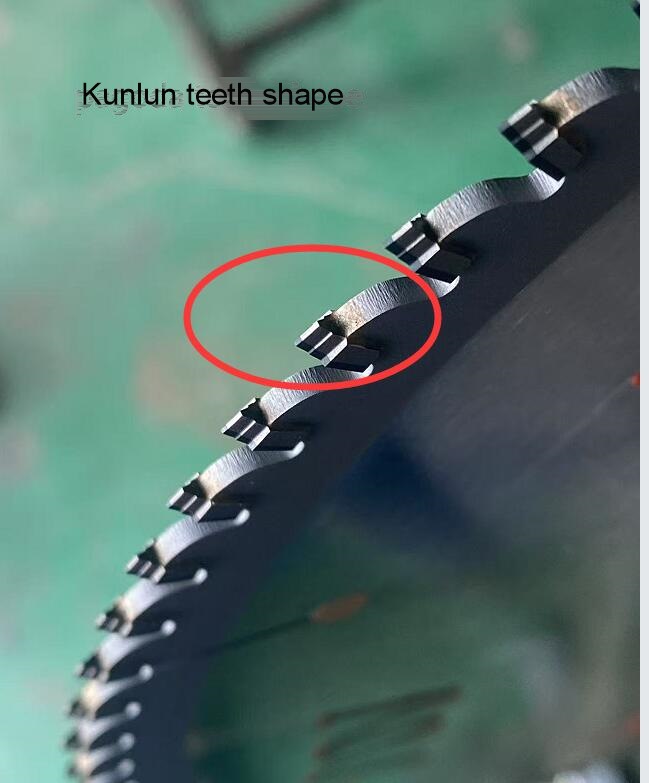
Kunlun Teeth
Saw Blade Bodies Behind Kunlun Teeth: Plate, Tension, Flatness
Tips cut; the body decides whether the cut stays true. Plate steel, tensioning, flatness and bore tolerance, plus four questions to ask a blade supplier.

Ask a buyer what makes a good saw blade and the answer is usually about the teeth: tip material, tooth count, geometry. All true, and all wasted if the plate behind the teeth cannot hold its shape at speed. The body is the least visible part of a Kunlun tooth blade and the part that most often decides whether the blade cuts cleanly or merely cuts. This article is for buyers and maintenance engineers who have specified the tooth profile correctly and still see a cut that wanders, a blade that screams, or an edge that varies across the run - and who need to know which properties of the body to question before blaming the tips.
Three jobs the body has to do
A blade body has three responsibilities, and they are separable. It has to locate the cutting edge precisely on the arbor, hold that geometry flat and true under centrifugal load, and absorb cutting forces without deflecting. If it fails at any one of them, the tips cannot compensate: a deflecting blade cuts with variable pressure, and variable pressure produces chipped edges and a finish that changes from panel to panel.
That is why a blade that cuts well on the first panel and badly on the hundredth is usually describing a body problem, not a tip problem.
Plate steel and heat treatment
Bodies are made from alloy steel plate selected for flatness, hardness and internal soundness. The steel has to be hard enough to resist wear at the arbor and denting in handling, and uniform enough that heat treatment does not warp it. Plate with internal stresses will move after machining, and a body that has moved cannot be corrected by sharpening or by re-aligning the machine.
Buyers rarely see this. What they see is a blade that was true when it arrived and is not true three months later, and a supplier who cannot explain why. The explanation is usually in the plate and the heat treatment, not in the tips.
Why tensioning is invisible and decisive
Tensioning pre-stresses the plate so that it runs flat at operating speed. As the blade spins, centrifugal force tries to distort it; tensioning counteracts that by building a controlled stress pattern into the plate. A properly tensioned blade runs true at its rated speed. An untensioned or badly tensioned blade wobbles, and the wobble shows up as a wide, ragged cut, a screaming blade and an edge that will not hold tolerance.
Tensioning leaves no trace in the finished blade, which is exactly why buyers should ask about it. A supplier who can describe their tensioning and inspection process is a different proposition from one who answers the question with the word "balanced".
Flatness, thickness and bore tolerance
Flatness tolerance decides how much the blade can wobble. Thickness decides stiffness. Bore tolerance decides whether the blade sits centred. On a thin-kerf PCD blade all three matter more, because a thin plate has less margin: the same runout that a thick carbide body absorbs will show up as edge damage on a thin one.
Bore tolerance is the one buyers can check themselves. A bore that slides onto the arbor with visible clearance is not a precision fit, whatever the drawing says.
Four questions for a blade supplier
1. What plate grade, and is it stress-relieved before machining? The answer should name a grade and a process, not a hardness number alone.
2. How is the blade tensioned, and how is tension checked? There should be a method and an inspection step.
3. What is the flatness tolerance, measured how? A figure without a measurement method is a marketing line.
4. Is the blade balanced after tipping, and is the bore inspected after finishing? Tipping adds mass; a blade balanced before tipping is not balanced.
Those four answers predict behaviour in production better than any line on a spec sheet about tip material. They also separate suppliers who manufacture bodies from suppliers who buy them finished.
What this means for a Kunlun tooth blade
A profile that controls the cut at entry and exit depends on the body holding its geometry. If the plate deflects, the stepped geometry no longer supports the panel the way it was designed to, and the edge quality that the profile is bought for is lost - while the tips are still perfectly sharp. When a Kunlun tooth blade underperforms, check the body before changing the blade specification.
Next step
ZHONGJIAN TECH manufactures PCD and carbide-tipped saw blades with the Kunlun teeth shape on tensioned alloy steel bodies, with machined bores and inspected flatness. Send your machine model, blade size and panel materials to ferrytk898@gmail.com or use the contact form on this site, and we will confirm the body specification alongside the tooth profile. If the problem you are chasing is a machine or mounting issue rather than a blade issue, we will say that too.