
Kunlun Teeth
Kunlun Teeth Shape vs a Scoring Saw: What Changes
A scoring unit against a single blade: where each wins on edge quality, setup, maintenance and tooling, and what to write on the order to compare quotes fairly.
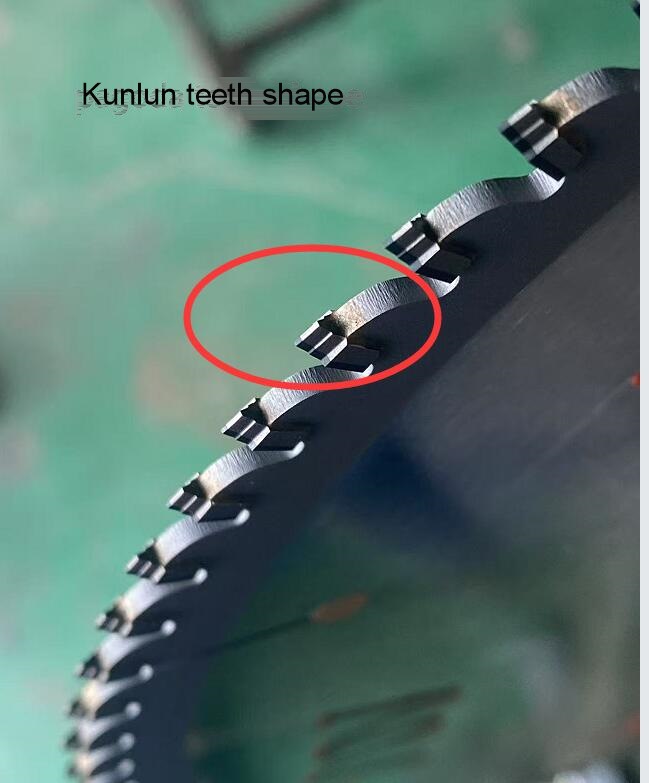
The choice between a scoring saw unit and a single Kunlun tooth blade is not a choice between good and cheap. It is a choice between two ways of controlling the same thing: what happens to the panel surface where the tooth exits. A scoring saw controls it with a second, shallow cut from underneath. The Kunlun teeth shape controls it with a conical, stepped profile that supports the material as the tooth enters and leaves. This guide compares the two on edge quality, setup, maintenance and tooling inventory, states where a scoring saw still wins, and sets out what to write on the order so that quotations can be compared fairly.
What you are actually buying
With a scoring unit you are buying a second spindle, a second blade, an alignment task and a maintenance point. With a single blade you are buying one cutting edge that has to do both jobs. Everything else in the comparison follows from that difference: the scoring setup buys repeatability through hardware, the single blade buys it through geometry and body quality.
Edge quality: what each setup controls
A scoring saw removes a shallow rebate from the underside before the main blade arrives, so the main blade exits into a pre-cut groove instead of into finished surface. It works, and it works on a very wide range of materials, because the mechanism does not depend on the main blade's tooth geometry.
The Kunlun teeth shape works differently. The stepped profile supports the panel at the cut line so that fibre is cut rather than torn on both faces, and the decorative face and the core edge come off the machine without a second operation. The difference in practice is that a scoring saw protects the underside, while the profile protects both faces - which is what matters on double-sided laminated board.
Setup and changeover
A scoring unit has to be aligned to the main blade: height, lateral offset, and parallelism. That alignment is a per-setup task, it drifts as blades wear, and it is the first suspect when edges start chipping. A single blade removes those steps, and with them the most common reason a job has to be stopped and re-set.
This is where the comparison usually becomes visible to the people running the line rather than to the buyer: fewer adjustments before the first panel, and fewer checks between jobs.
Maintenance and tooling inventory
Two blades mean two sharpening cycles, two reorder points and two sets of spares kept on the shelf. A scoring blade wears differently from a main blade, so the two are never due at the same time, and the inventory question is not only cost but the risk of stopping because one of a pair is at the sharpener. A single blade collapses that to one cycle and one spare.
Where a scoring saw still wins
Honesty matters more here than advocacy. A scoring unit remains the safer choice when the panel mix includes materials the profile was not specified for, when the machine is already equipped and amortised, when the edge standard is extremely demanding and the process is already validated, and when the blade is likely to be abused - reclaimed board, material with hard inclusions, or operators who push feed rates beyond what a fine tooth count can clear.
A scoring setup also tolerates a wider spread of blade quality, because the mechanism hides some of the main blade's shortcomings. A single-blade process does not have that cushion.
What to write in the specification
1. Panel materials and the share of double-sided work. This decides whether the profile is being asked to protect one face or two.
2. Edge standard, stated as a defect. "No visible chipping at the trim line on the decorative face" is a specification; "clean cut" is not.
3. Machine model, blade diameter and bore. Including whether a scoring unit is currently fitted and could be retained.
4. Feed rate in production. A tooth count is meaningless without it.
5. Single- or double-sided cutting requirement. Named explicitly, because it changes the specification.
Comparing quotations fairly
A quotation for a single blade and a quotation for a scoring blade pair are not comparable line for line, even when both are correct. Put them on the same basis: cost per sharpening cycle, the number of cycles between changes, the downtime per change, and the cost of one downgraded panel. Then add the setup time the scoring unit consumes and the spare parts it requires.
The point of that exercise is not to produce a precise number. It is to stop the purchase being decided on unit price alone, which is the one measure on which a scoring blade will always appear cheaper.
Next step
If you are weighing the two options, send your machine model, panel materials and current edge standard to ferrytk898@gmail.com or use the contact form on this site. ZHONGJIAN TECH manufactures PCD and carbide-tipped saw blades with the Kunlun teeth shape, and we will tell you which of the two routes your panel mix actually supports - including when the answer is to keep the scoring unit.