
Kunlun Teeth
Scoring-Saw-Free Panel Cutting with the Kunlun Teeth Shape
How one conical step blade trims both faces of a panel without a scoring saw, which defects it removes, and which jobs should still keep a scoring unit.
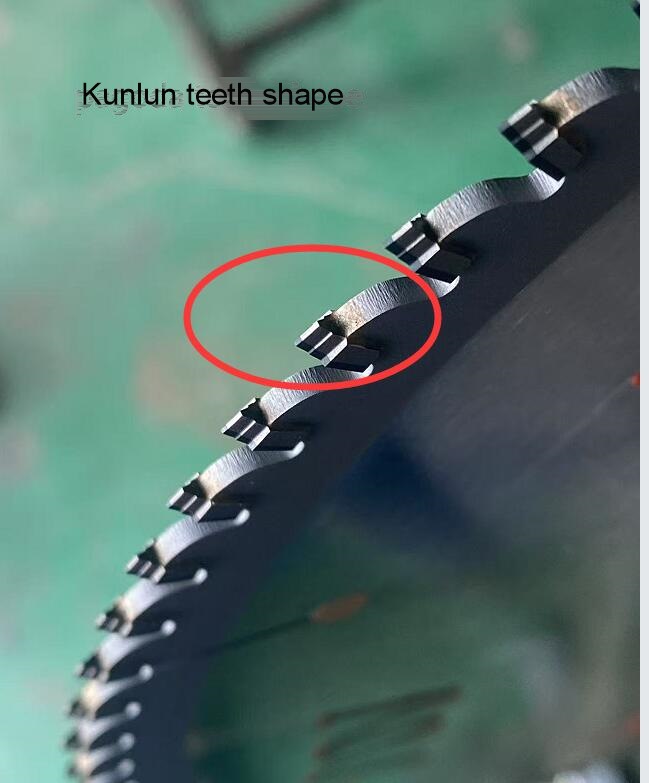
Scoring-saw-free panel cutting means one blade trims both faces of a panel in a single pass, so the exposed edge leaves the machine without the second, shallow cut from underneath that a scoring unit would normally make. It works by controlling where the chip separates: the Kunlun teeth shape uses a conical, stepped profile that holds the material as the tooth enters and leaves, so the decorative layer is severed instead of lifted. This page explains the mechanism, the four practical advantages that follow from it, how single- and double-sided panels behave on the same blade, and what the profile does not replace. It is the overview; the specification detail belongs on the blade sizing and specification pages.
What the shape does in the cut
A conventional tooth is designed to clear material. It arrives at the surface, takes a chip and leaves - and in the moment it leaves, the material behind it is unsupported. On a laminated or painted face, that unsupported moment is when the surface layer breaks away from the core, which is what a chip is.
The stepped profile changes that moment. The conical geometry supports the panel at the cut line while the tooth is in the material, so the chip separates along the cut rather than pulling surface material with it. The same geometry works on the way in, which is why the entry face benefits as well as the exit face.
This is a mechanical argument, not a claim about sharpness. The profile does not cut more aggressively; it cuts with more support on both sides of the cut line.
The four advantages on the shop floor
One blade instead of two
Only one conical step blade is needed for preliminary trimming on panel edges. The scoring unit, its spindle, its adjustments and its maintenance point come out of the setup.
Fewer edge defects on exposed panels
Chipping, burr and notch tearing are reduced because the material is supported where the chip separates. The visible result is an edge that can go to banding or assembly without being sorted first.
Consistent edges along the run
Edge quality that depends on a scoring alignment drifts as blades wear and as settings move. Edge quality that depends on the tooth geometry and the body stays where it was set, which is what keeps the last panel of a batch looking like the first.
Single- and double-sided panels on one blade
The profile is specified for both. On double-sided work it replaces the score-then-cut sequence; on single-sided work it usually removes the need for a sacrificial backer board.
One blade, no scoring unit - and both faces leave the machine ready for banding or assembly.
Single- and double-sided panels on one blade
The difference between the two cases is which face is vulnerable. On single-sided board, only one face is decorative, and the failure mode is a chip on that face. On double-sided board both faces are visible, so the blade has to control the exit face as carefully as the entry face - which is precisely the condition a scoring saw was invented for.
Working both on the same machine is where a single-blade process earns its place in a plant with a mixed order book: the setup does not have to change between a single-sided and a double-sided job, only the panel handling.
What it does not replace
The profile is not a substitute for a machine that runs true, a blade that is sharp, or a feed rate the tooth count can support. Runout, a worn tip, a damaged flange or an overloaded blade will produce defects that no tooth geometry can remove.
Nor is it the right blade for every material. Reclaimed timber that may hold nails or grit, rough sizing before machining, and any cut where the blade is likely to be abused belong on carbide or tool steel, which is cheaper to replace and more tolerant of impact.
And it does not remove the need for a first-article check. It removes the scoring adjustment, not the inspection.
Putting it to work
The order of work is: confirm the machine can carry the blade, specify the blade against the dominant panel and the edge standard, run one machine before converting a line, and record the first-article check so that drift is visible. Where double-sided work is a significant share of the volume, that sequence is what turns a blade purchase into a process that holds.
Next step
Send the machine model, the panel materials, the share of double-sided work and the edge standard you need to hold, to ferrytk898@gmail.com or use the contact form on this site. ZHONGJIAN TECH manufactures PCD and carbide-tipped saw blades with the Kunlun teeth shape for panel and composite cutting, and we will confirm whether the profile fits your line - or say so if another blade or a retained scoring unit is the better answer.