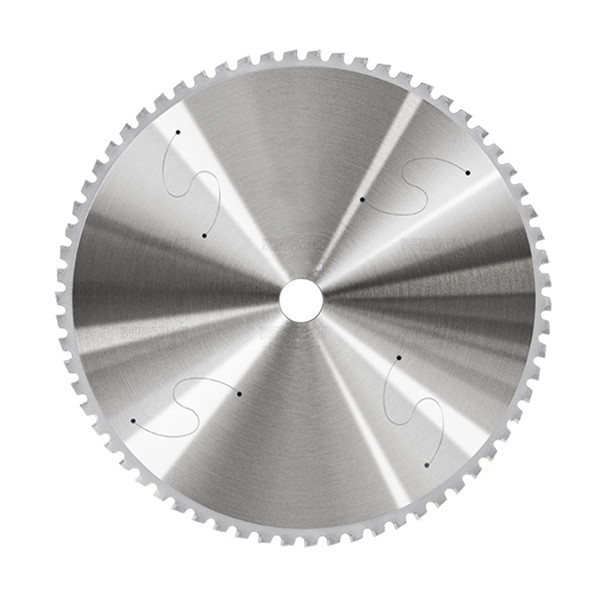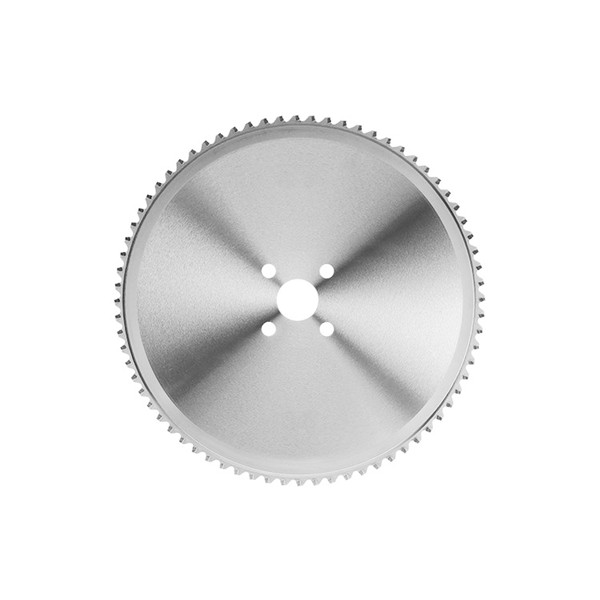
Cold saw blades and fly saw blades
HSS Circular Saw Blades with PVD Coating for Cold Saw Cutting
HSS M2 and M35 circular saw blades with TiN, TiCN or TiAlN PVD coating, 200 to 500 mm, 64 to 65 HRC, for cold saws cutting steel tube, bar and section.
Specifications
- Type
- HSS circular saw blade for cold saws
- Material
- HSS M2 (DMo5, 5% molybdenum) or HSS M35 (Co5%, 5% cobalt)
- Coating
- Steam oxide (uncoated), TiN, TiCN or TiAlN PVD
- Outer Diameter
- 200 mm to 500 mm
- Hardness
- 64 to 65 HRC (steam oxide standard)
- Cutting Capacity
- Solid or section up to 200 mm diameter or thickness
- TiN Hardness
- 2300 to 2500 HV 0.05
- TiCN Hardness
- 3000 HV 0.05
- Application
- Steel tube, structural section, solid bar and profile on cold saws
- Material Grade
- M2 for steel 500 to 800 N/mm2; M35 for steel and alloy over 800 N/mm2
- Customization
- Diameter, bore, tooth count and tooth angle produced to machine requirements
A cold saw cuts steel by chip removal, not by friction or abrasion. The blade is a toothed HSS disc running at low spindle speed under coolant, and the quality of the cut depends on the tooth geometry, the hardness of the steel and the coating on the tooth face.
These blades are made in HSS M2 (DMo5, 5% molybdenum) or HSS M35 (Co5%, 5% cobalt), from 200 mm to 500 mm diameter, with a standard hardness of 64 to 65 HRC in the steam oxide finish. They cut tube, structural section and solid bar up to 200 mm diameter or thickness.
M2 or M35: which steel grade
HSS M2 with 5% molybdenum is the general-purpose grade. It holds a good edge on steel alloys with tensile strength of 500 to 800 N/mm2 - mild steel, carbon steel and the common structural grades - and it is the economical choice for tubes, sections and solid bar up to 200 mm.
HSS M35 with 5% cobalt is the super high-speed grade. The cobalt raises hot hardness, so the tooth keeps its edge when the cut runs hotter: stainless steel, high-alloy steel and any material over 800 N/mm2. It costs more per blade and lasts longer in those materials, which is why the two grades are stocked side by side rather than one replacing the other.
What the PVD coating changes
PVD is a thin hard film deposited on the finished tooth. It does not change the blade geometry, but it changes what happens at the cutting edge: surface hardness rises, friction between chip and tooth falls, and the tooth runs cooler. On a production cold saw that shows up as more cuts per sharpening and a lower cost per cut.
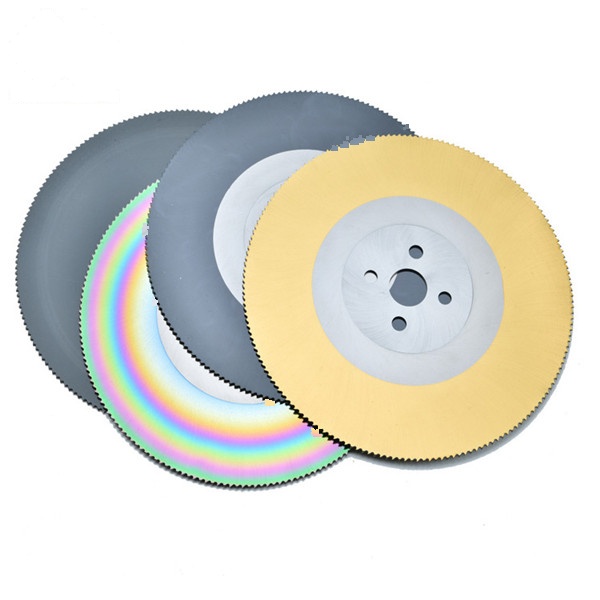
Steam oxide is the standard finish - a dark grey oxide layer that holds a little coolant and suits general-purpose cutting, including non-ferrous work, across the 200 to 500 mm range.
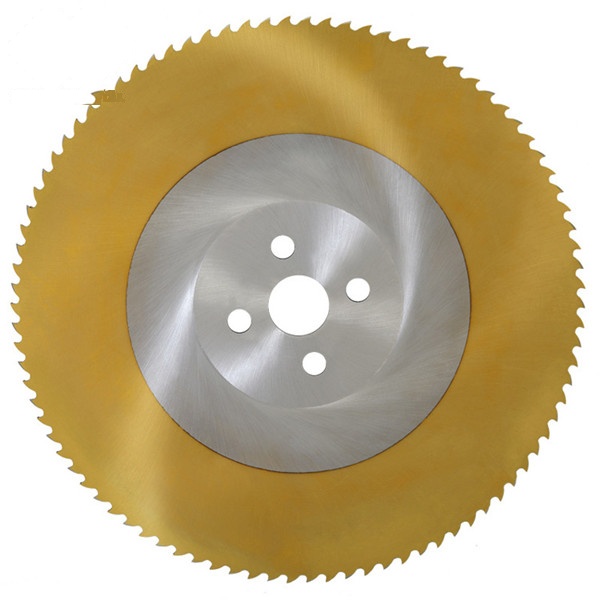
TiN is the gold coating. It raises surface hardness to 2300 to 2500 HV 0.05 and can be used on all materials including stainless steel. It is the most common upgrade from steam oxide.
TiCN is blue to purple. At around 3000 HV 0.05 it has higher abrasion resistance and better heat resistance than TiN, which allows a faster cutting rate on abrasive or work-hardening material.
TiAlN is purple to grey. It is the toughest of the three and is intended for the highest machining rates with minimal lubricant, particularly stainless steel and high-temperature alloys, and for cutting that runs dry or near-dry.
Tooth angles are set for the section, not the blade
The same blade body can be ground with different tooth angles for different work. A pipe or thin-wall tube needs a finer pitch and a different rake from a solid bar of the same diameter, because the tooth has to survive an interrupted cut on the tube wall but a continuous chip in solid material. We grind the tooth form to the application rather than shipping one general-purpose geometry for everything.
How to specify the blade
Five values decide the order: outer diameter, thickness, bore, tooth count and the material being cut. The machine sets the first three; the material and section set the last two. If you are replacing an existing blade, a photograph with the markings visible plus the machine make and model is enough to match it.
On a cold saw the coating does not make a bad tooth geometry work - it makes a correct geometry last longer.
ZhongJian Tech manufactures TCT, PCD and HSS circular saw blades for metal and panel cutting in Futian Town, Anyuan District, Pingxiang City, Jiangxi Province, China. Send the material you cut, the machine make and model, and the blade size you run now, and we will confirm the specification and quotation. Email ferrytk803@gmail.com, phone / WhatsApp +86 13617995900.
Frequently asked questions
What do I check before ordering?
This blade is 200 mm to 500 mm. Match three things against the machine: the outer diameter against the saw’s capacity, the bore and pin holes against the spindle, and the tooth geometry against the section being cut. The bore is easy to measure; the pin holes are where machines of the same brand often differ. Where the arbor differs, the same tooth geometry is built to your spindle rather than you adapting the machine.
Which materials does it cut?
Steel tube, structural section, solid bar and profile on cold saws. Stay inside that range: a blade run in harder or more abrasive material than it was ground for loses its edge quickly, and the cut quality drops before the edge visibly fails.
What should I quote when I inquire?
HSS Circular Saw Blades with PVD Coating for Cold Saw Cutting — plus the quantity and the machine make and model. Those three are enough to confirm the specification, the minimum quantity for the size and the production lead time in the quotation. When replacing a worn blade, a photograph of the marking stamped on the old blade shortens the check further.