Sawmill TCT Saw Blades with Clearing Teeth: 400 mm, 24 Teeth and 4 Clearing Teeth
What a clearing tooth does on a sawmill TCT blade, why 400 mm with 24 main teeth and 4 clearing teeth works, and what to send before a blade price can be quoted.
A sawmill blade is asked to do something a workshop blade never is: cut through a log, in one pass, all day, in wet or frozen timber. The sawdust has nowhere convenient to go, the heat has nowhere convenient to go, and the blade is buried in the material for the full depth of the cut.
That is why sawmill blades are built with clearing teeth. A clearing tooth — also called a raker tooth, a cleaner tooth or a gullet tooth — is a lower, narrower tooth inserted into the tooth sequence. It does not take the finish cut. It clears the kerf.
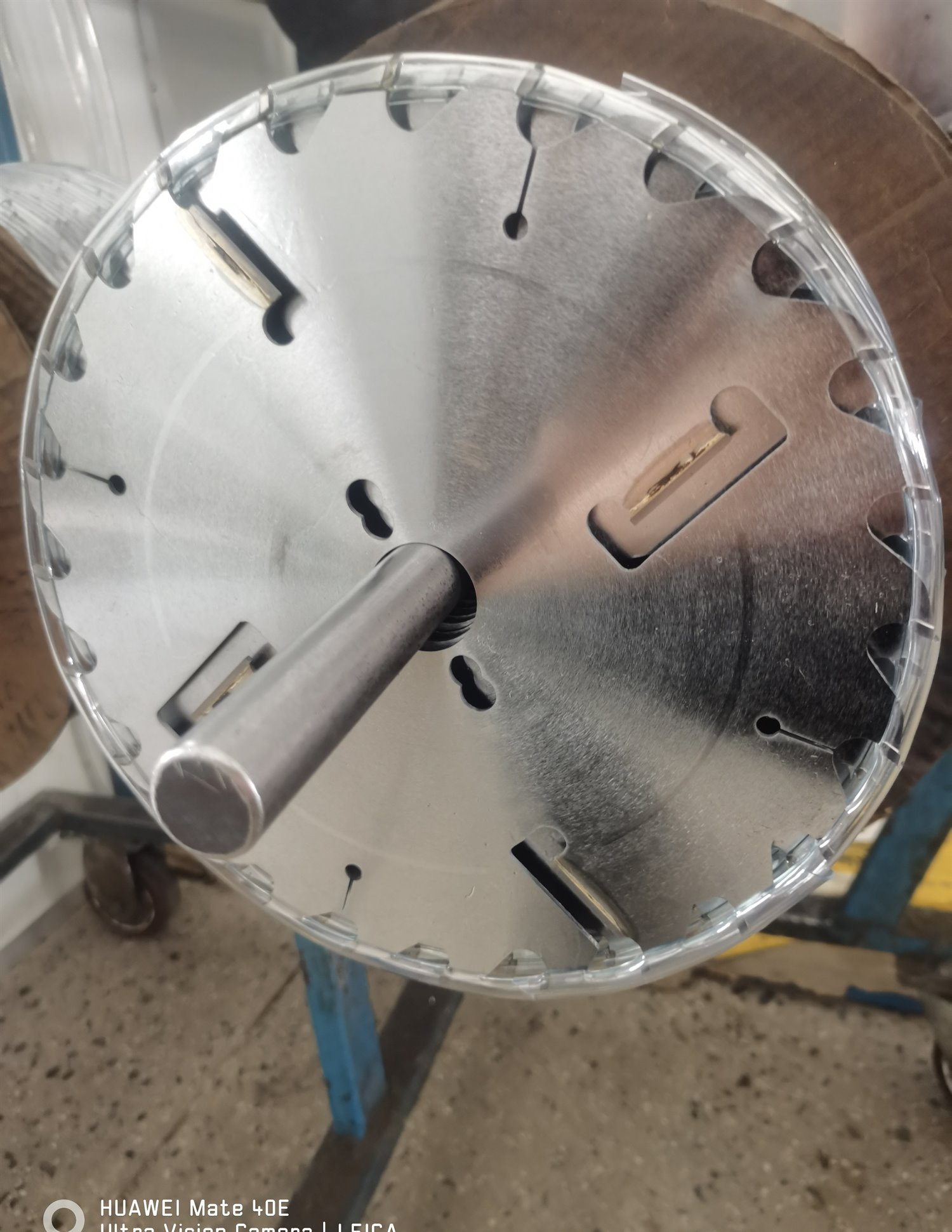
The blade in the photograph is exactly this type of build: main teeth around the full rim, four clearing teeth worked into the tooth circle, laser-cut expansion slots and a tensioned plate, photographed in its protective guard. What follows explains how that design works, why a 400 mm blade with 24 teeth and 4 clearing teeth is a sensible specification for a sawmill, and what information we need before a price can be given.
What a clearing tooth actually does
In a normal rip cut the main tooth lifts a chip and the gullet in front of it carries that chip out of the kerf. On shallow cuts in dry timber this works. On a sawmill, three things break it down.
First, the chip volume is enormous — a deep cut in green softwood produces long, stringy chips that pack rather than flow. Second, the kerf is closed on both sides, so there is no side escape. Third, the blade is running hot and the resin in green timber makes chips stick.
A clearing tooth solves this by taking a narrower bite than the main teeth, at the bottom of the kerf, and dragging the packed material out. Because it sits lower in the tooth sequence, it does not define the cut surface — the main teeth do. Because it takes a narrower path, it does not widen the kerf. Its only job is transport.
The side effects are worth as much as the clearing itself. A cleared kerf generates less friction, so the blade runs cooler. A cooler blade holds tension longer, so it stays straight. A straight blade cuts to dimension, and a blade that cuts to dimension is what a sawmill is actually buying.
Why 400 mm with 24 teeth and 4 clearing teeth
A 400 mm blade is a mid-size sawmill and multi-rip diameter: large enough for production log breakdown on a smaller mill or for edging and resaw work on a larger one, small enough to run on a machine that does not have unlimited spindle power.
Twenty-four main teeth on a 400 mm blade gives a tooth pitch that clears a large chip gullet while keeping enough teeth in the cut to hold a stable line. Fewer teeth loads each tooth harder and produces a rougher surface; more teeth gives a finer cut but a smaller gullet, which is the wrong direction in green timber.
Four clearing teeth means one clearing tooth every sixth position in the tooth sequence. That distribution is the practical one: frequent enough that chips are cleared before they pack, sparse enough that the clearing teeth do not dominate the cutting action or upset the balance of the tooth load.
This combination — 400 mm, 24 main teeth, 4 clearing teeth — is one of the recurring sawmill specifications we are asked to quote. It is not a catalogue part; it is a specification that gets built to a drawing once the machine, the timber and the finish requirement are known.
What else is fixed by the machine, not by the blade
A diameter and a tooth count do not define a blade. Five other dimensions are decided by the machine and the job, and a blade quoted without them is a guess.
The bore. Sawmill arbors are commonly 30 mm or 50 mm but the actual spindle, the flange diameter and the presence of pin holes or drive keys all matter, because a blade that is not driven positively on the arbor will slip or spin.
The kerf and plate thickness. Kerf sets how much timber becomes sawdust; plate thickness sets how much the blade can be tensioned and how much power it absorbs. A thin plate saves timber but is less tolerant of a worn machine.
The tooth geometry. Hook angle, tooth shape, top and side clearance angles and the carbide grade are all chosen against the material: green softwood, dry hardwood, frozen timber and engineered wood want different geometry.
The clearing tooth form. A clearing tooth can be a lower-profile tooth in the same sequence, a narrower tooth, or a distinct form with its own clearance. The right answer depends on the chip volume the machine produces.
The maximum running speed. Every blade carries a maximum speed determined by its design and its tip material. The machine must run at or below it — this is a safety limit, not a preference.
What determines the price of a sawmill blade
We do not publish a single price for a 400 mm 24-tooth blade with 4 clearing teeth, because the range between the cheapest and the correct blade for a given mill is wide and the difference is in the build, not the label.
The variables that move a saw blade price are:
Diameter and plate thickness — more steel, more tensioning work, more carbide.
Tooth count and tooth geometry — 24 teeth means 24 individually brazed carbide tips, ground on both faces and both sides; more teeth, more grinding passes.
Clearing teeth — each one is an additional machined feature with its own tip and its own clearance work.
Carbide grade — standard grades and grades for abrasive or frozen timber sit at different price points.
Tensioning and flatness — this is skilled labour, and it is the part of a sawmill blade that decides whether it runs true at production speed.
Surface treatment — polished, painted or coated, and whether the blade needs a brand mark or a customer-specific marking.
Quantity — a single blade and a scheduled repeat order are not the same unit price, and a repeat order is where a sawmill actually saves money.
Packaging and shipping terms — a 400 mm blade is an awkward, heavy, sharp object to move; export packing and Incoterms change the landed cost as much as the blade specification does.
That is why the useful answer to "what is the price" is a quotation built on your machine data, not a number invented for a web page.
The information to send for a quotation
Send these and a real quotation can be produced: blade diameter; bore diameter and any pin holes or drive keys; required kerf; plate thickness if known; number of main teeth; number and arrangement of clearing teeth; the material being cut and whether it is green, dry or frozen; the machine make and model and its spindle speed; the surface finish the mill needs; the quantity for the first order and the expected annual volume.
A photograph of the machine arbor and of the blade currently in use is often worth more than a written description, because the flange, the guard and the existing blade all give away details that a specification sheet leaves out.
How the blade in the photograph is built
The plate is laser-cut and then tensioned — the hammering or rolling that puts controlled stress into the steel so the blade stays flat and true when it heats up in the cut. Expansion slots are cut into the rim area to let the plate grow thermally without distorting.
Carbide tips are brazed into the tooth seats, then ground: face, top, both sides and the clearance angles. The clearing teeth are formed into the same sequence with their own lower profile and their own clearance geometry.
Every blade is checked for flatness and tension after grinding, checked for tip brazing soundness, and marked with its specification and maximum speed. A sawmill blade that is out of tension will cut a curved line long before it fails, so this check is the one that protects the customer.
Frequently asked questions
Do you make saw blades for sawmills with clearing teeth in the middle? Yes. Clearing teeth are a standard option on our TCT sawmill and multi-rip blades, and the 400 mm / 24 main teeth / 4 clearing teeth layout is one of the specifications we quote regularly.
How many clearing teeth should a 400 mm blade have? Four is the common arrangement for 24 main teeth — one clearing tooth per six positions. A mill cutting very resinous or frozen timber may go to more; a mill cutting clean dry stock may need none. The choice follows the chip volume, not a rule.
Can I run the blade faster than the marked speed? No. The marked maximum speed is a design limit related to the tip material and the plate. Exceeding it is a safety issue and a warranty issue.
Can the blade be re-sharpened? Yes, and it must be. A TCT sawmill blade is re-ground on all four faces of each tip, and the tooth geometry is restored at the same time. A blade that is re-sharpened before it dulls holds its line and its kerf far better than one run until it stops cutting.
Why is a quotation needed instead of a price list? Because bore, kerf, plate thickness, tooth geometry and carbide grade all change the build, and a sawmill blade is not interchangeable between machines.
What is the minimum order? Sample and single blades are possible for evaluation; production and repeat orders are quoted separately because the economics change with volume.
ZhongJian Tech manufactures TCT circular saw blades, PCD blades and industrial machine knives in Dongguan, Guangdong, China, including sawmill blades with clearing teeth built to customer drawings. Send your blade diameter, bore, kerf, tooth count, clearing tooth count and the machine you run, and we will confirm the specification and a quotation. Email ferrytk898@gmail.com, phone +86 13617995900, WhatsApp +86 15397991985. Address: 3F, No.1, Sec.1, Xinzhou, Xinan, Changan, Dongguan 523882, Guangdong, China.